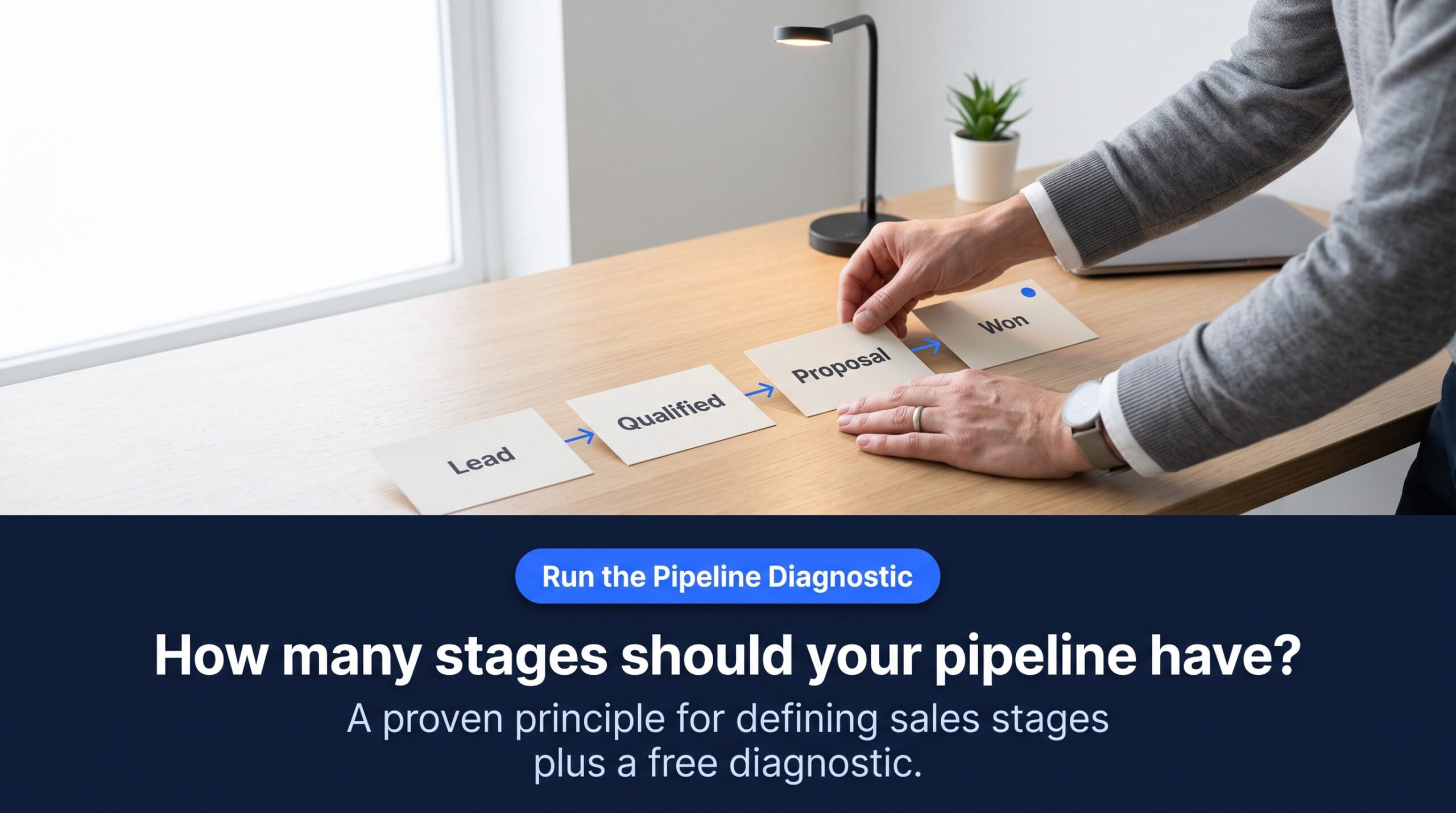
Sales pipeline stages are the successive thresholds an opportunity crosses on its way from first contact to close. That much every guide will tell you. But there is a principle most of them stay quiet about, and it decides whether your sales pipeline predicts anything at all: a well-defined stage describes the decision the buyer has made, not the activity the rep has performed.
That sounds like a nuance. In practice it is the difference between a forecast and a guess. When a stage is called “Proposal sent,” it only tells you what your team did. It does not tell you whether the buyer even concluded they have a problem worth solving. And only the latter can be forecasted.
Key Takeaways
- A sales pipeline stage should describe the state of the buyer’s decision, not the rep’s activity.
- Every stage needs an entry criterion: a sentence answering “what must be true for a deal to be here.”
- Between 40 and 60% of qualified B2B deals are lost not to a competitor but to “no decision” (JOLT Effect, Dixon and McKenna, 2022).
A Common B2B Sales Pipeline Stage Set
Since you are here, you want to see a list. Here is a typical set of five stages, but treat it as a reference point, not a recipe. Notice that each one is named for a buyer state, not a rep task:
- Qualified: the buyer fits the profile and there is a real reason to talk now.
- Need recognized: the buyer has named the problem and its cost themselves, not just you.
- Decision-maker engaged: a person with budget and authority is at the table.
- Offer on the table: the buyer is evaluating a specific solution and knows the price.
- Decision: the buyer says yes, no, or consciously puts it off.
See the pattern? For each stage, add one question: what must be true for a deal to land here? That is the entry criterion. Without it, a stage is just a drawer a rep drops a deal into when “something moved.” And the stakes are real: between 40 and 60% of qualified B2B deals end not in a loss to a competitor but in “no decision” (JOLT Effect, Dixon and McKenna, 2022), most often right where no stage forced a check on whether the buyer had truly judged the problem worth solving.
How Many Stages Should a Sales Pipeline Have?
As many as actually change your decision about what to do. No more. More stages is not more control, it is more places where a deal can get stuck for no reason.
Ask yourself a simple question at each stage: if a deal stalled here, would I do anything different than at the stage next door? If the answer is “no,” it is not a separate stage, just decoration. Five stages, each forcing a different response, forecasts better than nine that describe the same move sliced thin. If you run a small services company, see what this looks like in a 30-person software house pipeline.
Where Stage Definitions Break
Three mistakes recur in nearly every B2B sales pipeline I have ever cleaned up.
Stages describe you, not the buyer. “I called,” “I sent the proposal,” “I ran the demo.” That is like labeling warehouse shelves “called the supplier” instead of “goods ready to ship.” A label about you says nothing about whether the shipment goes out.
No exit criterion. A deal enters a stage, but no one has defined what has to happen for it to leave. The result: deals live in one stage for weeks, and you call that “pipeline.” Without exit criteria, pipeline velocity and pipeline coverage stop meaning much, because both depend on knowing which stage a deal is really in.
“Probability” assigned by gut. A stage gets a 60% chance of closing because that is how it has always been done. This is where forecast inflation comes from. Only 35% of reps fully trust the data in their pipeline (Salesforce, State of Sales, 2024). A stage that predicts anything bases probability on the observable state of the buyer’s decision, not on a hunch.
FAQ
What are the stages of a B2B sales pipeline? Most often: qualified, need recognized, decision-maker engaged, offer on the table, decision. The specific names matter less than the principle: each stage should describe the state of the buyer’s decision and have a clear entry criterion.
How many stages should a B2B pipeline have? As many as actually change your response. Usually between four and six. If two adjacent stages do not force different action, merge them.
What’s the difference between a pipeline stage and a funnel stage? A marketing funnel describes the audience’s attention: awareness, interest, consideration. A sales pipeline describes the buyer’s commitment to a specific deal. The first measures reach, the second measures decision.
When does a lead enter the pipeline? When it meets the entry criterion of the first stage: it fits the profile and there is a real reason to talk now. Not the moment a rep “felt” it was worth it.
What’s Next
Stages are only the skeleton. The real difference in predictability comes from how you manage them over time: how you measure conversion between them and how you clear out what has stalled.
Next: Sales pipeline management, the operating-system view of revenue →
Quick self-check (Pipeline Diagnostic): walk through your stages and ask one question at each. Does it describe the buyer’s decision or the rep’s activity? If more than half describe your team, you already know why your forecast does not add up.