How to Stop Losing Customers Halfway: A Complete Guide to Customer Journey Mapping



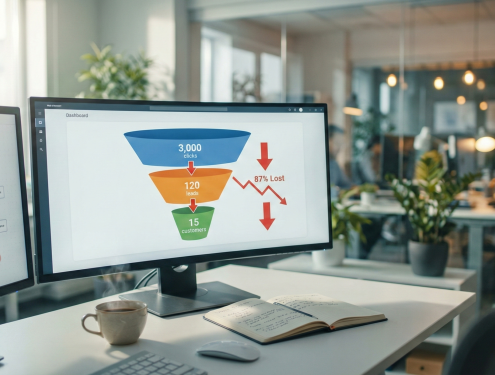
I was sitting with a client once, looking at Google Analytics, and he stared at me with complete confusion. „Tom, look—we have 3,000 visits to the landing page from ads, but only 24 conversions. Something’s wrong with the ad or the landing page.”
We checked the ad. Great CTR. We checked the landing page. Solid time on page, decent scroll depth. Technically everything was fine.
The problem wasn’t the ad. The problem wasn’t the landing page.
The problem was that this client thought customer journey looked like this: Ad → Click → Purchase.
And reality? A completely different story.
When we dug into 6 months of data, something fascinating emerged. A typical B2B customer who ultimately bought had this path:
Day 1: Sees Google Ads ad. Clicks. Browses landing page for 2 minutes. Leaves. Day 4: Searches Google for reviews about the product category. Lands on competitor’s article. Day 8: Sees remarketing on Facebook. Ignores it. Day 12: Colleague from the industry mentions a similar solution on LinkedIn. Clicks on comment. Day 15: Returns to landing page via branded search. Reads case study. Day 18: Downloads PDF with solution comparison. Day 23: Has urgent problem at work. Returns. Fills out demo form. Day 28: Buys.
28 days. 7 touchpoints. One purchase.
And we were only looking at the first and last point, wondering „why is conversion so low.”
That was the lesson that changed my approach to campaigns. Because over the following years working with over 100 clients and budgets exceeding 100,000 PLN monthly, I understood one thing: most companies lose customers not because they have a bad product or poor ads. They lose them because they try to sell on first contact instead of guiding them through the entire journey.
Today I’ll show you exactly how to map customer journey so you finally understand where you’re losing customers and how to win them back. This isn’t academic theory. It’s a proven process that we use at LabRoi with every client before launching the first campaign.
Why „Ad → Click → Purchase” Is a Marketer’s Fantasy
Let’s start with a brutal truth.
Research shows that the average number of touchpoints before purchase in B2B is between 6 and 8. In some industries it reaches 20. And the average time from first contact to purchase decision? From 3 weeks to 6 months, depending on transaction value.
Now think about what most marketing campaigns look like.
The ad says: „Buy now!” The landing page says: „Fill out the form!” The follow-up email says: „Are you ready to buy?”
And everyone wonders why conversion is 2%.
Because it’s like walking up to someone on the street, saying „Hi, I’m Tom, marry me” and expecting them to respond „Yes, wedding’s on Saturday.”
Absurd, right? Yet that’s exactly what most companies’ campaigns look like.
A customer at the first stage doesn’t want to buy. They don’t even know yet that they have a problem. Or they know, but don’t know solutions exist. Or they know solutions exist, but don’t know which to choose. Or they know which to choose, but aren’t ready to make a decision.
Each of these stages requires a different message. Different content. Different call to action.
And if you don’t understand this, you’ll forever be fighting for conversions instead of collecting them.
Anatomy of a Real Customer Journey (Not the One from Presentations)
At LabRoi we divide customer journey into 5 stages. Not because that’s what textbooks say, but because over years of observing data we see the same pattern repeating across dozens of industries.
The first stage is problem unawareness. The customer is living peacefully. They have some problems, but either don’t notice them or treat them as „normal.” „Yeah, we’ve always lost 20% of leads between marketing and sales. That’s how it is in this industry.”
At this stage, an ad saying „Buy our CRM” is like talking to a wall. The customer doesn’t know they need a CRM. They’re not searching for CRM. They’re not clicking on CRM ads.
What will interest them? Content that shows them the problem exists. An article „Why 73% of B2B Companies Lose Customers Between Marketing and Sales.” A report „5 Hidden Problems in Lead Generation Process That Cost You Millions.” A case study „How Company X Discovered They Were Losing 200k Annually Due to One Process Mistake.”
The second stage is problem awareness. The customer now knows they have a problem. They feel the pain. But they don’t yet know how to solve it. They’re searching for information. Educating themselves. Reading articles, watching webinars, downloading reports.
Here the ad „Buy our CRM” still won’t work. But this will: „Free guide: How to Fix Communication Between Marketing and Sales in 30 Days.” Or: „Webinar: 3 Strategies for Recovering Lost Leads.”
The third stage is solution consideration. The customer knows they have a problem and that solutions exist. Now they’re comparing options. Seeking reviews. Analyzing case studies. Looking at prices.
Only now can you show your product. But not as „buy now,” rather as one of the options to consider. Demo, trial, comparison with alternatives, specific case studies with numbers.
The fourth stage is decision. The customer is almost ready. They need a final push. Proof that it’s a good decision. That others did the same and don’t regret it. That risk is low.
Here testimonials work, guarantees, time-limited offers, conversation with a salesperson who dispels final doubts.
The fifth stage is retention and advocacy. The customer bought. And now they’ll either become your ambassador or leave for the competition at the first opportunity. Onboarding, customer success, follow-up—all of this determines whether lifetime value will be high or one purchase and done.
Most companies focus only on stages three and four. Ad → Purchase. And that’s why they have poor results.
How to Map Your Customers’ Actual Journey (Not the Imagined One)
Ok, theory is nice, but how do you do this in practice?
At LabRoi we have a proven process we call „Customer Journey Audit.” It takes about 6-8 hours of work, but the results are worth every minute.
Step one is gathering data on actual behaviors. We don’t assume we know what the journey looks like. We check.
You go into Google Analytics (or whatever analytics tool you use) and look at conversion path reports. How many sessions before conversion? How many days? What channels? In what order?
You’ll be surprised. With practically every client I see the same amazement when I show the actual data. „Seriously? Average 5 sessions before purchase? I thought it was max 2.”
If you have a CRM, check the contact history with customers who bought. How many emails before the decision? How many phone calls? How many downloaded materials?
Step two is customer interviews. And this is gold.
You don’t ask „how did your purchase process go?” Because people don’t remember exactly. Instead you ask:
„What made you start looking for a solution like [your product] in the first place?” „When did you first think you had this problem?” „What were you doing before you found us?” „What other options did you consider?” „What ultimately convinced you to decide?” „What almost stopped you from buying?”
These questions uncover the real journey. The trigger that started the search. Alternatives they considered. Objections they had. The moment of decision.
One of my clients in the SaaS industry was convinced their customer journey started with Google Ads. After interviews with 12 customers, he discovered that 9 of them found the company through a recommendation or LinkedIn, and Google Ads was only the third or fourth touchpoint. The entire acquisition budget was going to a channel that was actually the middle of the funnel, not the beginning.
Step three is mapping touchpoints. You take a large board (or Miro/FigJam) and draw a timeline. From the moment the customer first encounters your product category to the moment of purchase and beyond.
For each stage (unawareness, problem awareness, consideration, decision, retention) you write down:
This is the moment when most companies have an epiphany. Because suddenly they see that their landing page answers questions from stage three, but the ad is directing people there from stage one. Disconnect.
Where You’re Losing Customers (and How to Fix It)
With the journey mapped, you can start looking for holes. And believe me, there will be some.
The first typical hole is lack of content at early stages. The company has a great product landing page, but zero educational content. A customer at the problem awareness stage has nowhere to go. Either they land on the landing page and leave because they’re not ready for a sales pitch yet.
Solution? Blog, webinars, reports, guides. Content that educates, doesn’t sell. That builds trust and demonstrates expertise.
I had a client with 1.2% conversion from Google Ads. We did an audit and it turned out 60% of traffic was „how to [solve problem]” queries—meaning problem awareness stage. And the landing page was immediately pitching the product.
We created a series of educational articles. We rebuilt the campaign so that „how to” queries directed to articles instead of the landing page. On the articles we added remarketing and lead magnets.
Result? Conversion from articles to leads: 8%. Conversion of those leads to customers: 15%. Total sales increase of 340% with the same budget.
The second typical hole is lack of follow-up between touchpoints. Customer downloads a PDF, and then… silence. Or they get one email „Are you ready for a demo?” and that’s it.
It’s like inviting someone on a first date, it goes great, and then you’re silent for 3 weeks and suddenly write „Marry me.”
The solution is nurture sequences. A series of emails, remarketing, content that guides the customer through subsequent stages. Doesn’t sell immediately, just builds relationship and delivers value.
At LabRoi we design what we call „escort paths.” For each entry point (ad, article, webinar, referral) we have planned the next 5-10 touchpoints that guide the customer to the moment when they’ll be ready for a sales conversation.
The third typical hole is lack of objection handling. The customer is interested but has doubts. And there’s nowhere to find answers. FAQ on the site? Three questions about delivery and payment. Case studies? One, from 3 years ago.
And customer objections are things like: „Will this work in my industry?”, „How long will implementation take?”, „What if the team doesn’t want to use it?”, „Can I cancel if it doesn’t work?”
The solution is systematically collecting objections (from sales conversations, customer interviews, competitor reviews) and creating content that addresses them. Case studies from different industries. Detailed descriptions of implementation process. Testimonials about team adoption. Clear cancellation terms.
One client added a section on their landing page „What skeptics who tried say”—testimonials from people who initially had doubts. Conversion increased 23% in 2 weeks.
Building Touchpoint Sequences (Practical Example)
Alright, let’s get concrete. I’ll show you what a touchpoint sequence looks like for a typical B2B SaaS customer.
Let’s say you’re selling a marketing automation tool. Your ideal customer is a marketing director at a company with 50-200 employees.
Problem unawareness stage. The customer has a team that manually sends emails, manually segments lists, manually analyzes results. They think „that’s how it’s done” or „automation is for bigger companies.”
Your touchpoint: article „Why Marketing Teams at 50+ Companies Lose an Average of 15 Hours Weekly on Tasks That Should Be Automated” or „Report: How Mid-Size Companies Scale Marketing Without Additional Headcount.” Promoted through LinkedIn ads targeted at marketing directors.
Customer reads the article. Thinks „hmm, we also waste a lot of time on these things.” Maybe downloads a PDF with checklist „10 Marketing Processes to Automate.” Leaves email.
Problem awareness stage. Now they know they have a problem. They’re searching for more information.
Your email sequence (spread over 2 weeks):
Email 1 (day 1): Thank you for downloading + link to case study „How Company X Saved 20 Hours Weekly”
Email 2 (day 4): Educational article „5 Marketing Automation Mistakes That Cost Companies Thousands”
Email 3 (day 8): Webinar „How to Choose an Automation Tool—What to Look For”
Email 4 (day 12): Case study from customer’s industry (if we have data)
Parallel remarketing: ads with educational content, not sales content.
Solution consideration stage. Customer starts comparing options.
Only here do you come in with the product. Email with demo invitation. Retargeting with product landing page. Comparison with alternatives. ROI calculator.
Decision stage. Customer almost ready, has final doubts.
Here’s what works: conversation with salesperson who dispels objections, testimonials from similar companies, trial or pilot, satisfaction guarantee, offer with deadline.
The entire sequence can last from 2 weeks to 3 months, depending on decision complexity and transaction value. And throughout this time the customer receives valuable content, not sales spam.
How to Measure Customer Journey Effectiveness (Metrics That Make Sense)
Most companies look at one metric: conversion from ad to purchase. And that’s a mistake.
Because if your journey has 7 touchpoints and you only measure the first and last, you don’t know where you’re losing people.
At LabRoi we teach clients to look at metrics for each stage transition.
Transition from unawareness to problem awareness: how many people from cold traffic (first time on site) engage with educational content? How many download lead magnets? How many subscribe to newsletter?
Transition from problem awareness to consideration: how many people from nurture sequence open emails about the product? How many click links to case studies? How many visit the pricing page?
Transition from consideration to decision: how many people request a demo? How many fill out contact forms? What percentage of demos convert to proposals?
Transition from decision to purchase: what percentage of proposals accepted? What’s the average time from demo to purchase? What objections cause refusals?
When you measure each transition separately, you see exactly where the bottleneck is.
I had a client with great conversion from demo to purchase (40%), but very low from lead magnet to demo (5%). The problem wasn’t the product or sales. The problem was the nurture sequence that wasn’t building enough interest.
We redesigned the emails. Instead of two emails „download more materials,” we created a sequence that gradually built urgency and showed the cost of not acting. Conversion to demo rose to 12%.
Same product. Same landing page. Just a better middle part of the journey.
Tools That Actually Help (and Which Are Overhyped)
I won’t push you that you need expensive software to map customer journey. Because you don’t.
For basic mapping, a Miro or FigJam board is enough. Or literally a large piece of paper and post-it notes. What matters is the thinking, not the tool.
For data analysis you need Google Analytics 4 (free) and access to your CRM. If you have HubSpot, Pipedrive, or Salesforce, you already have everything you need.
For email sequences, any decent marketing automation platform—whether HubSpot, ActiveCampaign, Mailchimp, or anything else. It’s not about the tool, it’s about the strategy.
What’s overhyped? Expensive „customer journey mapping” platforms that cost thousands monthly and in practice are glorified Miro boards. Or „AI-powered journey analytics” that generate pretty dashboards but zero actionable insights.
If your budget is limited, invest in better analytics and more customer interviews, not fancy software.
Most Common Journey Mapping Mistakes (and How to Avoid Them)
Over years of working with clients I’ve seen hundreds of customer journey maps. And the same mistakes repeat over and over.
Mistake one: mapping the journey you WANT customers to have, not the one they ACTUALLY have. Everyone would like the customer to see an ad, click, and buy. But it doesn’t work that way. Map reality, not wishes.
Mistake two: ignoring touchpoints you don’t control. Customer searches for reviews on Google, reads reviews on Capterra, asks friends on LinkedIn. All of this is part of the journey, even if you can’t directly control it. You can influence—through actively managing presence in those places.
Mistake three: one journey for all customers. Different segments have different paths. A small company buys differently than a corporation. A new market buys differently than a mature one. Segment journey by customer types.
Mistake four: mapping once and forgetting. Customer journey evolves. The market changes, customer behaviors change, new channels appear. Do a journey audit minimum once per quarter.
Mistake five: focusing only on acquisition. Journey doesn’t end at purchase. Onboarding, customer success, upsell, referral—all of this is part of long-term customer value. And often that’s exactly where the biggest opportunities are.
What to Do Now (Concrete Action Plan)
Ok, you have tons of information. Now the question: what to do with it?
Here’s my recommended plan for the next 2-4 weeks:
Week 1: Gather data. Go into Google Analytics and check actual conversion paths. How many sessions before purchase? How many days? What channels? Review contact history in CRM for the last 10 customers who bought. Write down all touchpoints.
Week 2: Conduct interviews. Talk to minimum 5 customers. Ask the questions I mentioned earlier. Record conversations (with permission). Note key insights: triggers, alternatives, objections, decision moments.
Week 3: Map the journey. Take a board (physical or virtual) and draw a timeline. For each stage write down what you discovered in data and interviews. Identify holes—places where content, touchpoints, or answers to objections are missing.
Week 4: Plan actions. For each identified hole, plan a specific action. Content to create. Email sequence to design. Remarketing to launch. Assign responsibilities and deadlines.
This isn’t rocket science. It’s systematic work. But the results can be spectacular.
Summary: Stop Shooting Blind
Returning to the story from the beginning of the article. That client who had 3,000 visits and 24 conversions? After mapping the journey and building a full touchpoint sequence, from the same traffic he now has 180+ conversions monthly.
Same product. Same landing page. Similar budget.
The difference? Understanding that customer journey isn’t „ad → purchase.” It’s a series of touchpoints, each of which must answer questions and solve customer problems at that moment.
Over 13 years of managing campaigns I’ve seen hundreds of companies trying to shorten the journey. „Maybe if we give a bigger discount they’ll buy faster.” „Maybe if we’re more aggressive in follow-up.” „Maybe if we change the button color.”
That doesn’t work.
What works? Understanding where the customer is. What they need at that moment. And delivering it—without pushing for purchase before they’re ready.
If you want to see how the LabRoi methodology can help map and optimize customer journey at your company, you’ll find more materials at labroi.co. We publish case studies, templates, and practical guides you can apply immediately.
Because remember—every day without understanding your customer journey is a day of losing customers halfway. And no advertising budget will fix that.
Tom Piskorski, Senior Marketing Campaign Specialist, 13+ years of experience managing Google Ads, Meta Ads, and LinkedIn Ads campaigns for B2B companies across Europe. Has managed budgets exceeding 100,000 PLN monthly and helped over 100 clients in 7+ languages optimize their marketing performance. Find more practical advice at labroi.co.

Podaj firmowy adres email aby czytać dalej.
Odblokowujesz także wszystkie pozostałe artykuły na stronie!