How to Stop Losing 87% of Your Leads: A Complete Guide to Nurturing Sequences



I was once sitting in a meeting with a client, looking at his Google Analytics dashboard. 3,000 clicks per month. Landing page converting at 4%. 120 leads.
„Great result, right?” he asked proudly.
„How many of them buy?” I replied with a question.
„15.”
„And the rest? 105 leads just vanish into thin air?”
Silence.
„Yeah… but that’s normal, isn’t it? Not everyone is ready to buy.”
And that’s exactly the problem. Because it’s not normal. That’s 87% wasted effort. 87% of advertising budget that brought a click, brought a lead, and then… nothing.
Over the next 3 months, we built a nurturing sequence for this client. Remarketing with an educational article. Email with a case study. Retargeting with customer testimonials. Nothing complicated.
Result? Instead of 15 customers per month – 42. Almost three times more. Zero additional budget for traffic acquisition.
It wasn’t magic. It was understanding one fundamental truth about how people actually buy.
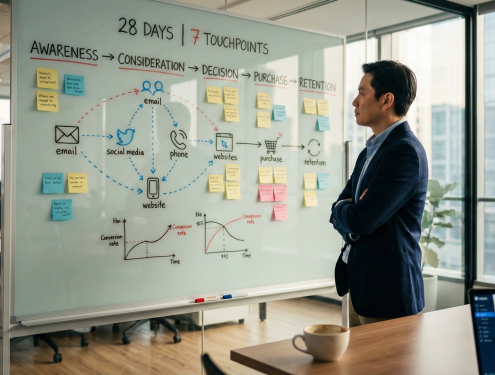
Before I get into the specifics, you need to understand purchasing psychology. Because most marketers design their campaigns as if customers see an ad, click, and immediately pull out their wallet.
That’s not how it works. It never worked that way.
Research consistently shows the same thing: 80% of people need 3 to 7 contacts with a brand before making a purchase decision. In B2B, that number often rises to 8-12 contacts.
Think about your own purchasing decisions. When was the last time you bought something worth more than $100 after the first contact with a brand? Probably a long time ago. Maybe never.
What do you do instead? You go to the website. Read. Compare with competitors. Leave. Come back a week later. Read reviews. Ask friends. Go back again. And only then – maybe – you buy.
This is the normal buying journey. The problem is that most companies treat every person who didn’t buy immediately as a „lost lead.”
That’s not a lost lead. That’s a customer halfway through the journey.
And if you don’t have a system that guides them through that journey, then yes – you’ll lose them. But not because they weren’t interested. Only because no one helped them make the decision.
Let’s do some quick math, because numbers always bring clarity.
Let’s say you spend $2,500 per month on ads. You get 3,000 clicks (cost per click around $0.83). Of that, 4% leave contact info – you have 120 leads. Cost per lead: about $21.
Now let’s say 15 of them buy. Your customer acquisition cost (CAC) is $167.
What happened to the remaining 105 leads? Each of them cost you $21. That’s $2,205 per month you spent acquiring people… who then disappeared.
Now imagine you have a sequence that converts not 12.5% of leads (15 out of 120), but 35% (42 out of 120). Your CAC drops from $167 to $60. Almost three times cheaper.
And most importantly – you didn’t spend a single extra dollar on advertising. You utilized what you already had.
This is the real power of nurturing. It’s not about generating more leads. It’s about closing more of the ones you already have.
One LabRoi client once told me: „Tom, for two years I kept pumping budget up because I thought the problem was too few leads. Turned out the problem was too few contacts with the leads I already had.”
Before I show you how to build a sequence, you need to understand WHY people don’t buy immediately. Because if you don’t understand this, your emails and remarketing will look like desperate „buy now, buy now, BUY NOW.”
And that doesn’t work. It repels people.
People don’t buy immediately for several reasons. And each of these reasons requires a different approach in the sequence.
The first reason is lack of problem awareness. The customer knows that „something is wrong,” but can’t name their problem yet. They see your ad, click, read… but don’t connect it to themselves. „Nice, but that’s probably not for me.”
Your sequence must first help them SEE their problem. Not sell the solution. Show the problem.
The second reason is fear of change. Even if the customer knows they have a problem, change is difficult. The current situation is known. The new one is unknown. And people naturally choose known evil over unknown good.
Your sequence must show that change is safe. Case studies. Testimonials. Guarantees. Everything that reduces risk.
The third reason is lack of urgency. The customer thinks: „Ok, I should do this. But not now. Maybe in a month. Next quarter. Someday.”
Your sequence must show the consequences of NOT acting. What will happen if nothing changes? What will be the costs of waiting?
And the fourth reason – lack of trust. The customer doesn’t know you. Doesn’t know if you’re credible. If you’ll keep promises. If others are satisfied.
Your sequence must build authority. Educational content. Social proof. Transparency.
See the pattern? A nurturing sequence isn’t a series of emails with a „buy” button. It’s a series of contacts that systematically removes purchase barriers. One by one.
Alright, let’s get concrete. What should a nurturing sequence look like?
Over the years, we’ve tested various approaches at LabRoi and arrived at a framework I call „7-14.” Why? Because the optimal sequence lasts 7 to 14 days, depending on product complexity and price.
Products under $100? 7 days is enough. B2B products for several thousand? 14 days minimum.
The framework consists of three phases that correspond to three mental states of the customer.
Phase one is „Problem Recognition” and usually lasts 2-3 days. Here you don’t sell. Here you help the customer see and name their problem. Educational content. Articles. Checklists. Everything that says: „Hey, I see you have this problem. Here’s what it looks like. Here are its consequences.”
The goal of this phase is to make the customer think: „Damn, that’s EXACTLY me. This guy understands my situation.”
Phase two is „Solution Exploration” and lasts 3-5 days. Here you show that a solution exists and that you have it. But you still don’t push „buy now.” You show case studies. Comparisons. Webinars. Demos. Everything that says: „Here’s how others solved this same problem. Here’s how THIS works.”
The goal of this phase is to make the customer think: „Ok, I see this solution works. I see proof.”
Phase three is „Decision” and lasts 2-4 days. Here you finally ask for the purchase. But in the context of everything that came before. You show the offer. Remove final doubts. Give a reason to act NOW.
The goal of this phase is to make the customer think: „Ok, I have enough information. Risk is low. I’m taking action.”
Let’s get into the details. What exactly should be in each phase?
In the „Problem Recognition” phase, three types of content work best. The first is an educational article that describes the problem without selling a solution. Example title: „5 Signs You’re Losing 80% of Your Leads (And Don’t Even Know It).”
This article should describe symptoms of the problem in a way that makes the customer think „that’s me.” You use language you’ve heard from your customers. Quotes from conversations. Specific examples.
The second type is a checklist or self-assessment. Something like „Assess in 3 Minutes Whether Your Sales Funnel Has Holes.” People love diagnostic tools. They give them a sense of control. And importantly – they engage actively instead of passive reading.
The third type is a short „person to person” email that says: „Hey, I saw you downloaded [thing] / signed up for [thing]. I wanted to ask – what was the main reason? What are you dealing with right now?”
This email does two things. Builds relationship (someone reached out personally). And gives you information (you can segment responses and adjust further communication).
In the „Solution Exploration” phase, case studies, comparisons, and webinars work best.
A case study isn’t „a story about our wonderful client.” A case study is „a story about a problem someone SIMILAR TO YOU had and how they solved it.” Structure: starting situation (with numbers), what they tried before (and why it didn’t work), what they did with us (specifically), results (with numbers).
A comparison answers the question „how are you different from X?” before the customer asks it. You can compare your approach to alternatives. You don’t have to attack competition. You can show: „Here are three ways to solve this problem. Here are the pros and cons of each. We do it this way, because…”
A webinar or demo is the moment where you show the product in action. Not a feature list. You show how the customer uses the product to solve THEIR problem. „Imagine you have 100 leads per month and want to know which ones are warm. Here’s what you do…”
In the „Decision” phase, three elements work.
An offer with a specific CTA. Not „learn more.” But „schedule a 30-minute call where I’ll show you exactly how this works in your industry.” Specific. Low risk.
Concentrated social proof. Not „we have 500 satisfied customers.” But „3 companies in your industry increased conversion by an average of 180%.” The closer to the customer, the better.
An urgency element. Not fake („offer ends tomorrow” and then continues anyway). Real. „We have room for 3 new clients this quarter because onboarding takes 2 weeks.” Or „prices go up next month because we’re adding module X.”
An email sequence alone isn’t enough. People don’t open all emails. A 25-30% open rate is a great result. What about the rest?
That’s why a nurturing sequence must be multichannel. Email plus remarketing plus (optionally) phone or LinkedIn.
Here’s how it looks in practice.
Lead leaves contact. You immediately add them to a custom audience on Facebook and Google (through CRM integration or manually). And for the next 14 days, this lead sees your remarketing ads.
But note – remarketing ads must be synchronized with sequence phases.
Days 1-3 (Recognition phase): Ads direct to the educational article. The same one you mention in emails. Customer might not open the email, but will see the ad and click.
Days 4-8 (Exploration phase): Ads show case studies and testimonials. „See how [company similar to yours] increased conversion by 180%.” Link to case study.
Days 9-14 (Decision phase): Ads with specific offer. „Schedule a call – we’ll show you how it works in your industry.” Or „Last 3 spots this month.”
See the logic? The customer sees consistent messaging in different places. Email talks about the problem – ad directs to article about the problem. Email shows case study – ad does too. This builds trust and reinforces the message.
One LabRoi client had email open rate at 22%. We added remarketing synchronized with the sequence. Effect? People started responding to emails with words like „I saw you on Facebook too, read that article, nice.” Conversion rate increased by 40%.
Alright, enough theory. Here are specific templates you can copy and customize for your business.
Email 1 (day 0, right after signup):
Subject: Quick question about [lead magnet topic]
Body: Hey [Name], you just downloaded [resource name]. Great! I wanted to quickly ask – what was the main reason you were looking for it? What are you dealing with right now? Reply in one sentence – I’d be happy to point you to something that might help. [Your name]
This email is short, personal, and asks for a reply. People are more likely to respond to a simple question than to a long elaboration.
Email 2 (day 2):
Subject: The most common mistake I see with [target group]
Body: Hey [Name], in 13 years of working with [target group], I see one mistake that repeats almost everywhere. [Describe the problem – 2-3 sentences]. Most people think the solution is [common belief]. But the truth is different. [Link to article] – I wrote about this in more detail. Will take you 5 minutes and could save you [specific benefit]. [Your name]
PS: If you prefer a conversation – [calendar link]. 15 minutes, zero obligations.
Email 3 (day 4):
Subject: How [company/person] solved this same problem
Body: Hey [Name], remember the problem I wrote about? [Company] had exactly the same thing. [Brief description of situation – 2 sentences]. What did they do? [Brief description of solution – 2 sentences]. Result? [Specific outcome with numbers]. Full case study is here: [link]. Best, [Your name]
Email 4 (day 7):
Subject: Question: does this make sense for you?
Body: Hey [Name], over the past few days I sent you a few things about [topic]. I wanted to ask directly – is this something that interests you? If yes – let’s schedule a 20-minute call where I’ll show you exactly how it works. Zero sales. I’ll show you [specific thing you’ll show]. If not – let me know, I’ll stop writing about this topic. Here’s my calendar: [link]. Pick a time that works for you. [Your name]
This email is important because it gives the customer the ability to say „no.” Paradoxically, this increases conversion because people who respond „yes” are really interested.
Email 5 (day 10, for those who didn’t respond):
Subject: One last thing (then I’ll leave you alone)
Body: Hey [Name], I understand you might be busy. One last thing: I collected the 3 most important questions I get from [target group] and recorded short answers. [Link to video/article] If you ever come back to this topic – this is a good place to start. Best wishes and good luck with [their challenge], [Your name]
This email ends the sequence for the undecided but leaves the door open.
I know that’s a lot of information. So let’s turn it into a concrete implementation plan.
Week 1: Prepare content for the „Recognition” phase. One educational article describing your customer’s main problem. One checklist or self-assessment. Write emails 1 and 2.
Week 2: Prepare content for the „Exploration” phase. One case study (if you don’t have one – conduct an interview with a satisfied customer). Write emails 3 and 4.
Week 3: Prepare elements for the „Decision” phase. Page with offer or landing page with call signup. Write email 5. Configure email automation in your tool (ActiveCampaign, Mailchimp, whatever you use).
Week 4: Configure remarketing. Create custom audience from email database. Prepare 3 ad sets (one for each phase). Launch campaign.
Week 5+: Measure and optimize. Check email open rates. Check ad CTR. Check how many people get to calls. Test changes.
This is a realistic timeline. You can speed up if you have a team. You can slow down if you’re working solo. But don’t try to do everything at once. Better to have a simple sequence that works than an elaborate one sitting in drafts.
How do you know the sequence is working? Here are the metrics I track for every LabRoi client.
Email open rate – how many people open your emails. Benchmark for B2B is 20-25%. If you have less, work on email subjects.
Email click rate – how many people click links. Benchmark is 2-5%. If you have less, email content isn’t compelling.
Sequence conversion rate – what percentage of leads that entered the sequence get to a call/purchase. This is your main metric. If you have 5% and want 15%, you need to work on each element.
Lead to Customer rate – what percentage of all leads (before and after sequence) buy. Compare this with what you had before implementing the sequence. This shows real impact.
Time to conversion – how many days from first contact to purchase. If before it took 45 days and now it’s 20, the sequence is working.
I create a simple dashboard in Google Sheets for each client where we track these metrics weekly. Nothing complicated. But regularity is key.
Over years of work at LabRoi, I’ve seen hundreds of nurturing sequences. Here are the mistakes that repeat most often.
Mistake one: too much selling too early. Already the first email is „buy now.” People run away. Remember – the „Recognition” phase is education, not sales.
Mistake two: too infrequent communication. One email per week is too little. The lead forgets who you are. Optimal is every 2-3 days in the intensive phase, then you can slow down.
Mistake three: lack of personalization. „Dear customer” doesn’t build relationships. Use their name. Reference the specific thing the customer did (downloaded ebook X, attended webinar Y).
Mistake four: inconsistency between channels. Email says one thing, ad says another, website says a third. Customer is confused. Synchronize the message.
Mistake five: no clear CTA. Customer read the email and… doesn’t know what to do. Every email should have one, clear next step.
Mistake six: emails too long. Nobody reads elaborations. Emails in the sequence should be short. 150-250 words maximum. Put details in linked articles.
If the basic sequence is already working, here’s what you can add.
Segmentation based on behavior. Customer clicked on a retail industry case study? Next emails are about retail. Customer downloaded a small business checklist? Next emails talk about small businesses. This requires more advanced setup but increases conversion by 20-40%.
Lead scoring. You assign points for actions. Opening email = 1 point. Clicking = 3 points. Downloading case study = 5 points. When lead collects X points, sales gets a notification and calls.
Sequence branching. Depending on customer response, they go a different path. Responded that main problem is lack of leads? Path A. Responded that main problem is low conversion? Path B.
Personalized video. Instead of text email – a short video (you can record with Loom) where you speak directly to the customer. „Hey Mark, I saw you downloaded our checklist. I wanted to…”
These are things to do when basics are working. Don’t start with this.
Let’s go back to the beginning. 3,000 clicks. 120 leads. 15 customers. 105 „lost.”
These aren’t lost people. These are people halfway through the buying journey. They need 3, 5, 7 contacts before they buy. And if you don’t give them those contacts – they’ll go to someone who will.
A nurturing sequence isn’t a „nice to have.” It’s the foundation of every funnel that’s supposed to bring predictable revenue.
Build a simple sequence of 5 emails + remarketing. Align it with three phases: Recognition, Exploration, Decision. Measure results. Optimize.
One of my clients summed it up best: „I stopped burning budget on acquiring new leads because I’m finally closing the ones I already have.”
You don’t need more traffic. You need a system that guides people through the decision process.
You’re not losing leads. You’re guiding them. Step by step.
Tom Piskorski, LabRoi – Senior Marketing Campaign Specialist, 13+ years of experience managing campaigns for B2B companies. More articles on sales funnel optimization at labroi.co

Podaj firmowy adres email aby czytać dalej.
Odblokowujesz także wszystkie pozostałe artykuły na stronie!